Friday, February 28, 2014

Lubomyr Melnyk: comments on the divine [with his fingers].

This afternoon I left the bottling line (my job at the kombucha production facility) to attend a lecture/workshop by Lubomyr Melnyk, a modern composer regarded for his unique playing style which he calls “continuous music”. It was a welcome change from operating a bottling machine that was crushing bottles and going haywire for the day. Instead I transported myself to my alma mater, Portland State University, and spent the afternoon taking in the sunshine on my walk to the music building, before witnessing a fantastic lecture by Melnyk in a small day-lit room with a piano (a Steinway!! which Melnyk lambasted for its apparent deficiencies in the upper range… he called it “half a piano” and went on to exclaim that this would never happen in Europe where Steinways are rarely encountered.) The disheveled, long-bearded Melnyk kept the small group of attendees in relative suspense as he lamented the Steinway and confessed to being in a bad mood on account of his luggage (containing some essential references for his lecture) having been caught up at the Canadian border. But the man of humble appearances quickly endeared himself with his authentic demeanor and palpable love for music and the art of his craft.

In the course of his lecture which culminated in an intimate performance, Melnyk rhapsodized at length about the various techniques and philosophies which inform and help to distinguish his music. He emphasized the training of the fingers, not simply in terms of the repetitious or compulsory learning of notes and scores by famous composers, and not just where to place the fingers and when, but how to place the fingers and with what sort of conviction. This instruction has resonance particularly for serious musicians striving for a high degree of facility on their instrument, but it also is an inspiration to anyone honing a craft and emphasizes the need for lengthy durations of practice. A style like Melnyks cannot be approximated. He has invented a way of playing which is uniquely his own. His finger movements stem from the wrists but have roots in his entire body. He says his gut so informs his playing that he avoids putting anything in his stomach before a concert.

During his performance (a piece which for all I know may have been invented on the spot) Lubomyr Melnyk and his small audience were (I’m prepared to say) transported into another realm of time. A space was created by the sound created by Melnyk that was like undulating fingers pouring over you in the form of melody.

These are the moments which I look for, or that find me with a lucky degree of regularity. That’s not to say that they can readily be compared one to the other. But it’s the stuff of patient people of subtle genius. Sometimes it's more pronounced, perhaps in the case of Melnyk who exuded an archetypal sage-genius inspiration that made him seem like a conduit for the sublime arpeggios of the cosmos. But it can happen to lesser, or simply different degrees. And in a way transitioning in and out of these moments of *special* space and time is becoming one of the great privileges of my life.

Tuesday, February 15, 2011

The Coming Technological Singlularity


The Singularity is something I've been meaning to bring to this forum for some time. What has kept me, I think, is the scope of its implications, and trying to say anything intelligible about it.

I think it was around 5 years ago when I first came across Vernor Vinge's concise but potent and provocative essay, The Coming Technological Singularity, in which Vinge outlines what he sees as an imminent future of super-human intelligence, at which point, he claims, "the human era will have ended." The time which Vinge expects this to happen by is 2030.

For those who don't know, Vernor Vinge is a sci-fi author, computer scientist and now-retired math professor. He's written a handful of Hugo Award-winning novels and novellas, including Fire Upon The Deep, A Deepness In The Sky, Rainbows End, and Fast Times at Fairmont High. His article on the singularity was published in 1993 in conjunction with a NASA-sponsored event called VISION-21 Symposium.

Basically, this short essay is something that I haven't been able to forget. It's like an impassive, left-justified afteraffect, or a whirling spiral funneling into oblivion that appears whenever I begin to think about 'human progress' and notions of morality.

For example, what prerequisite is there for environmental alarmism if machines are to be the next expression of evolution? 1

And for theists—what significance do popular conceptions of 'God' have in a universe where consciousness can be uploaded and preserved? 2

What will become of human selfhood, that perceived uniqueness which leads to ideas like 'soul'—as all forms of intelligence become omni-accessible—and by entities with a far greater capacity to create cogent understanding than ourselves?

Does this not turn Jesus of Nazareth and his all-too-human brand of prophecy on its nappy head?

I feel confident that a dizzying and accelerating stage of technological advancement is underway, and while there are always Ludites—history tends to preserve them as such.

Vinge concludes his essay thusly:

I think the new era is simply too different to fit into the classical frame of good and evil. That frame is based on the idea of isolated, immutable minds connected by tenuous, low-bandwith links.

He then goes on to quote the Amercian physicist, Freeman Dyson:

"God is what mind becomes when it has passed beyond the scale of our comprehension."

Time recently did a feature on The Singularity, check it out: 2045: The Year Man Becomes Immortal


1 I think the word 'machine' is provincial here. What we're really talking about is forms of AI that could foreseeably comprise processes which are quite biological.

2 And perhaps re-implanted in our bodies which might be healed or reconstructed through biological engineering

Wednesday, January 26, 2011

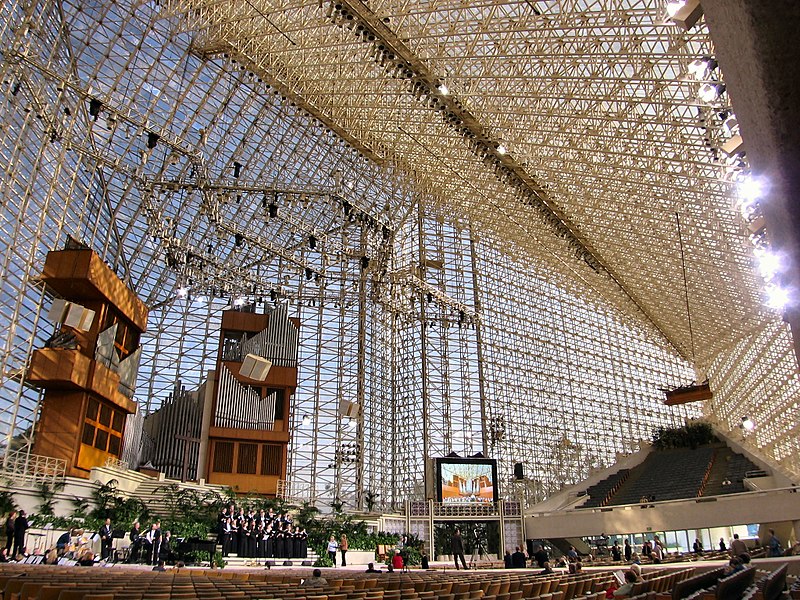
Crystal Cathedral files for bankruptcy


Two things I love in this post: architecture and mega-churches going under.

Crystal Cathedral, its glimmering 'prayer spire,' and the handy "International Center for Possibility Thinking" (whatever the fuck that means) constitute an almost-buffet of modern-master church architecture. With a collaborative work between Philip Johnson and Richard Neutra, and a later addition by Richard Meier, it's the sort of trove that an enterprising pastor might like to polish regularly with a soft, lint-free cloth, getting the in-between parts with a Q-tip and mild cleanser.

But the mega-church ministry behind the nice architecture has filed for bankruptcy, citing unrest among creditors and a 30% drop in revenue, largely a result of the weakening donation stream from the church's televangelist show "Hour of Power."

Reports of the news when it first broke in October depict a convoluted scene:

Huffington Post

Wall Street Journal

NPR

Sunday, January 16, 2011

The Game of Merit


Believe it or not, my grandfather invented this game. It's called Merit, "The Catholic Game," and it comes with "Ecclesiastical Approbation" and bearing the inscription:

"Unless you turn and become as little children you shall not enter the Kingdom of Heaven."


(That is, of course, Matthew: 18: verse 1-6, for those who don't know.*)

The game is meant to be a fun educational tool for kids and adults alike to learn the rules and commandments of Catholicism. I found it to actually be somewhat demanding. For example, what is it to land on "Extreme Unction"? No, don't get out your 'wonder killer,' aka iPhone, that's cheating.

(Extreme Unction, as the accompanying graphic seems to indicate, has to do with some sort of a deathbed blessing, or perhaps confession. Basically, it's something Christopher Hitchens will likely opt out of.)

In general, this board game (and my Grandpa Ed) gets two thumbs up for presentation and execution. It's a very refined product. Very much in line with other more established board games. It seems to be based on Monopoly, except instead of houses you plant churches, and instead of a shoe, you are Mary.

As for playability, it is difficult for people like myself who lack a Catholic education to play this game. It is very much an educational game, and perhaps not the best drinking/party game.

Questions range in difficulty from "Who made you?" (Answer = "God made you." Silly!) to ones more exacting and obscure, like:

Q: Name the sorrowful mysteries of the rosary?


A: Agony in the Garden, Scourging at the Pillar, Crowning of Thorns, Carrying of the Cross, Crucifixion and death of our Lord."


You may draw a card which says:

"SAY ALOUD ONE HAIL MARY THEN MOVE TO ANY LOCATION ON THE BOARD DESIRED."


or this one, which caused surprise/laughter/confusion (in that order):

"SAY ALOUD AN EJACULATION, THEN MOVE TO ANY LOCATION ON THE BOARD DESIRED."


(Next thing I know I'm googling "examples of ejaculations," this could only be bad...)

Basically, this game is kind of fun. I take it back, it is a good drinking game. Or a good 'educational tool' depending on your idea of an education. I suspect there aren't too many of these floating around out there with board/game pieces/cards intact, but if you happen to see Merit "The Catholic Game" in the Goodwill bins, say aloud one Hail Mary and snatch it up cos my Grandpa designed that game!

I've added some pictures at Flickr.

Saturday, January 15, 2011

The Alpha of Wikipedia


It's only too appropriate that one of the first and most controversial articles created in Wikipedia's infancy was that of Jesus Christ. Slate gives an interesting overview, as Wikipedia turns 10:

http://www.slate.com/id/2281294/

Monday, January 10, 2011

Good press for God

America loves a good rags-to-riches story. And God loves America.

I hope things continue to work out for this kind-hearted fellow...